 OK, here it is. Welcome to Data Analysis 101.
This is the kind of information that AXAnalyst will determine, and what every other data acquisition package leaves to you — interpreting what the data is telling you. Without this information, all you’re looking at is a series of numbers or graphs telling you something, but in a foreign language that you barely understand.
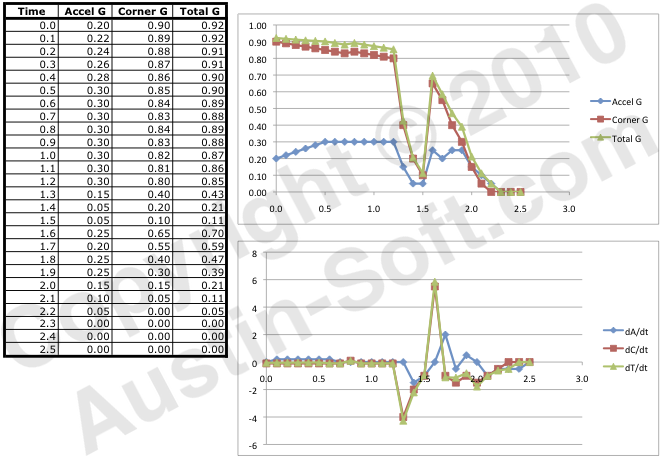
First, you’ll want to download the full-size image for this (just clicking on the image should open the image into a new window) so that we can refer to the image as we go through this post. This is a very simplistic set of data and graphs that I created to demonstrate some of the very basic knowledge you will need to know in order to determine what happened. Most of the time the information you’re looking at won’t be this clear-cut. On the left is the raw acceleration data, the graph on the top-right is the data plotted in a graph, on the bottom-right are the changes in acceleration (in Calculus terms, these are the first derivative of the acceleration values).
This example is basically what happens when you get wheelspin as you start to accelerate off of a corner. The car is accelerating pretty much at the maximum at 0.5 seconds into this example. Just when the driver is getting comfortable with the acceleration into the next straight the accelerating tires start to spin, which causes them to lose not just grip for accelerating, but also grip for cornering! In a front-wheel-drive car, the car suddenly goes straight-ahead (understeer), in a rear-wheel-drive car, the car now starts to spin (oversteer). Because dynamic friction (tires sliding or spinning) is less than static friction (tires gripping), that’s why the cornering values often drop because of wheel spin (and vice versa).
Of course recognizing this from the data is the challenge, and what makes it more difficult is that you don’t always see (or feel) the loss in performance, which is why a run can “feel” fast but actually be quite slow. Conversely, a run can “feel” slow but be quite quick. That’s why “feelings” aren’t used to tune cars or improve driver skills.
In the next installment, we’ll discover some more information about this small set of data and learn how just a tiny change can have a dramatic effect in time and speed.