Data Analysis 101-Intro

OK, here it is. Welcome to Data Analysis 101.

This is the kind of information that AXAnalyst will determine, and what every other data acquisition package leaves to you — interpreting what the data is telling you. Without this information, all you’re looking at is a series of numbers or graphs telling you something, but in a foreign language that you barely understand.

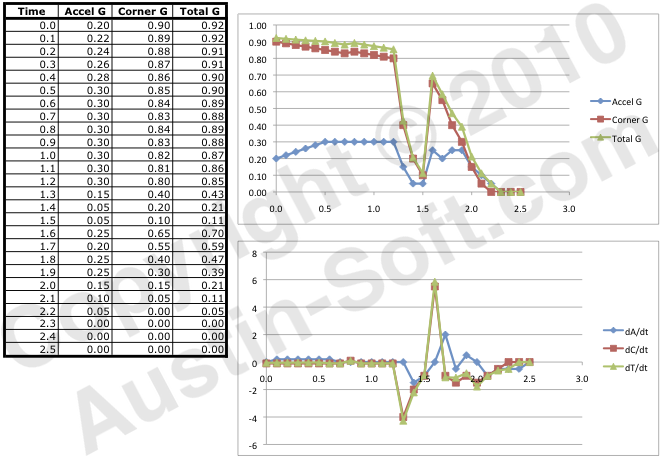
First, you’ll want to download the full-size image for this (just clicking on the image should open the image into a new window) so that we can refer to the image as we go through this post. This is a very simplistic set of data and graphs that I created to demonstrate some of the very basic knowledge you will need to know in order to determine what happened. Most of the time the information you’re looking at won’t be this clear-cut. On the left is the raw acceleration data, the graph on the top-right is the data plotted in a graph, on the bottom-right are the changes in acceleration (in Calculus terms, these are the first derivative of the acceleration values).

This example is basically what happens when you get wheelspin as you start to accelerate off of a corner. The car is accelerating pretty much at the maximum at 0.5 seconds into this example. Just when the driver is getting comfortable with the acceleration into the next straight the accelerating tires start to spin, which causes them to lose not just grip for accelerating, but also grip for cornering! In a front-wheel-drive car, the car suddenly goes straight-ahead (understeer), in a rear-wheel-drive car, the car now starts to spin (oversteer). Because dynamic friction (tires sliding or spinning) is less than static friction (tires gripping), that’s why the cornering values often drop because of wheel spin (and vice versa).

Of course recognizing this from the data is the challenge, and what makes it more difficult is that you don’t always see (or feel) the loss in performance, which is why a run can “feel” fast but actually be quite slow. Conversely, a run can “feel” slow but be quite quick. That’s why “feelings” aren’t used to tune cars or improve driver skills.

In the next installment, we’ll discover some more information about this small set of data and learn how just a tiny change can have a dramatic effect in time and speed.

Where do I start?

I’ve been thinking all week about what I want to write about next.

I’ve been really leaning towards showing the basics of how to read a data trace, so you know what it is that data analysts look for, and what AXAnalyst is designed to recognize for you. That means that I need to come up with some simple graphs that I can include on the page, and that is what is making it a bit more difficult at getting this discussion up on the page — hopefully in the next day or so.

So this is ending up being just a teaser. Sorry about that — the entrée is coming!

Analysis is more important than acquision

I was looking at some ads for data acquision products the other day and realized something – everyone has some kind of product that can record your runs, but trying to find a system that will analyze your runs to find out how to make you quicker is like trying to find four perfect “0.500s” in a row at a drag race or ProSolo.
Most software simply shows you various forms of the data that you have so carefully recorded, and leaves the “heavy lifting” of trying to figure out what the data actually means to the person looking at the screen – that means you. If you don’t have experience analyzing data, that expensive data recording system becomes “just another gadget” that occupies time between runs.
Professional race teams don’t depend upon the driver to interpret the data – they have highly-paid professionals who are experts in analyzing data. They can look at a small bump on a data trace and diagnose a serious problem with the car, the driver, or both.
Generally amateur racers don’t have that luxury. It is the rare driver who can be both a good engineer and a good driver. That’s why you see a lot of driver teams consisting of a good engineer and a good driver. The two skillsets are almost mutually exclusive, since the good engineer can generally extract only 100% of the car’s performance, but the good driver can modify the car’s envelope to find that extra 2-to-3% that is outside of the car’s natural envelope. This means that a good driver can – and usually is – sliding the car in small amounts to modify the attitude of the car to increase the envelope in the desired direction by sacrificing a less-desirable direction.
So, what does all of this have to do with AXAnalyst? EVERYTHING! AXAnalyst is that “professional engineer” back in the grid that can look at the data, analyze it, determine what isn’t working, and lead you to an alternate that will work better, in other words, what can make you faster. I’ve broken down years of expertise in car and driver engineering and written that into AXAnalyst. In addition, AXAnalyst can show you how you can modify your driving style to be even better – and faster.
I’ll get to technical info next week, but for now I’ll leave you with this thought: if you can’t look at the data and get the answer you need in less than five minutes, then your data acquisition system is not helping you.

Racing Season never ends

As I’m watching the snow fall this evening, I know that most people are looking towards the holidays and are probably not thinking about next season yet.

Not me.

I’m looking at this past season and realizing that I really fell down on my car setup for this past year. I let myself “live with” five years of car wear rather than objectively compare the data and fix the problems. While the car was still relatively competitive this year, it wasn’t as good as it could be.

I’m also looking at AXAnalyst and how I could have done more to make things easier. I had a lot of events where the path map were a lot closer to the course design, which means that I wasn’t taking advantage of the car’s ability to corner, so it means that I wasn’t carrying enough speed in corners. The data shows that, I just didn’t take advantage of that information at the time. I need to trust the data more!

Analysis is good only if it leads to change. The change can be good or bad, but you only know if you can improve only if you change. That’s the biggest thing. You might be successful where you are now, but you can only improve if you change.

Welcome to my thoughts…

I’ve set up this blog in order to post thoughts, hints, tips, insights, and anything else that can make your use of AXAnalyst and AXAnalyst+Video better — and make you a faster driver.

You see, while I originally wrote AXAnalyst for myself based upon years of data analysis and car engineering, I get a lot more satisfaction from hearing about how AXAnalyst has helped you become a faster and better driver. If you’re encountering problems or have any questions, I am here to help!

Hopefully I’ll be able to help you become a better driver and can help you find what may be holding you back from being a National Champion!